
Buy all ingredients right below the recipe
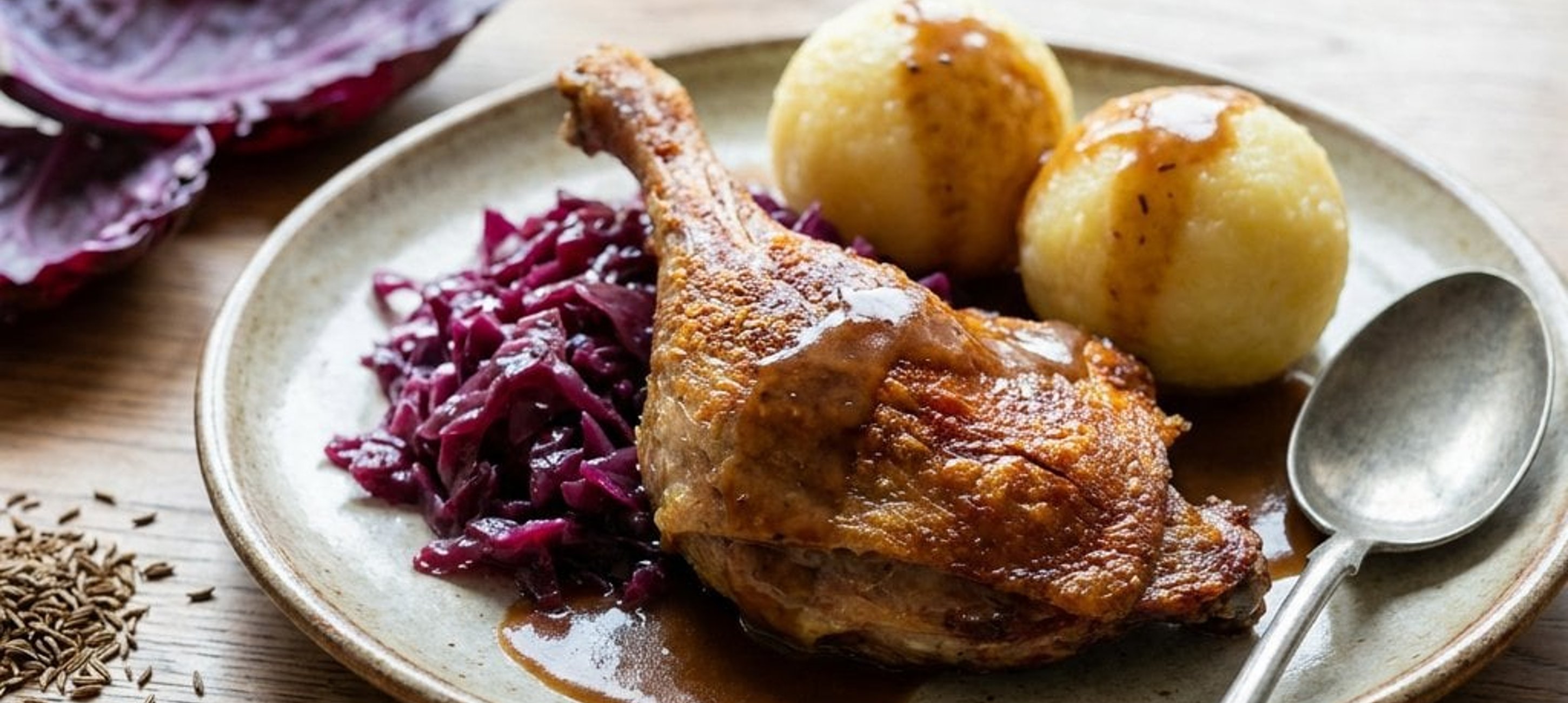
DUCK
- 1 fresh duck
- 20 g all-purpose flour
- 3 tablespoons caraway seeds (DUCK)
- salt (DUCK)
RED CABBAGE
- 1 head red cabbage (1.7 kg)
- 150 g peeled onion (CABBAGE) (merged)
- 150 g granulated sugar (CABBAGE)
- 80 g lard (CABBAGE) (merged)
- 150 ml vinegar (CABBAGE)
POTATO DUMPLINGS
- 1 kg potatoes, cooking type B or C
- 250 g coarse flour and for dusting the dough
- 1 tablespoon potato starch
- 2 eggs
DUCK PREPARATION
- 1Preheat the oven to 140 °C.
- 2Cut off the neck and the last part of the wings (the 'wingtips') from the duck and remove excess fat. Place the cut-off parts into a roasting pan and pour 200 ml of water over them. Thoroughly salt and cumin the duck – sprinkle salt and cumin into the abdominal cavity as well and rub thoroughly into the skin and meat. Place the duck on a rack in the preheated oven and place the roasting pan with the cut-off duck parts underneath it – the fat will drip into it during roasting. This way, you don't have to turn the duck, and it will roast golden brown on all sides.
- 3Roast the duck for approximately 2 hours or until tender. During roasting, occasionally baste the duck with the rendered juices. After roasting, remove the duck from the oven and let it rest in a warm place, or leave it in an open, turned-off oven.
- 4Remove the roasting pan that was under the duck from the oven, pour off the excess fat into a bowl (we will use it later for frying onions). Leave only the liquid from the drippings and a maximum of 1 tablespoon of rendered fat in the roasting pan. Place the roasting pan on the stove over medium heat, add the flour, and sauté it with a flat wooden spoon for 2–3 minutes until golden brown, stirring constantly.
- 5Pour in the remaining water and simmer for 20 minutes over low heat. Stir the residue formed during boiling on the bottom and sides of the roasting pan with a flat wooden spoon. Strain the cooked gravy through a fine sieve and, if desired, reduce it by ⅓ of its volume. This will give the gravy a stronger flavor. Serve with the duck.
CABBAGE PREPARATION
- 1Peel off the outer leaves from the head of cabbage and cut it in half. Cut the halves in half again and remove the tough cores. About 1.5 kg of prepared cabbage should remain. Cut the cabbage into fine strips.
- 2Finely chop the onion. In a saucepan over high heat, melt 60 g of lard, add the onion, and let it soften. Add cumin and sauté the onion until light golden, stirring frequently. Add the cabbage, stir, and push it to the side so that the bottom of the saucepan is partially visible. Sprinkle sugar onto the exposed bottom and quickly mix it in the fat. As soon as the sugar starts to turn golden, mix it thoroughly with the cabbage. Add salt, pour in vinegar, and mix thoroughly. Cover with a lid, reduce the heat to minimum, and simmer until the cabbage is soft. Occasionally stir the cabbage during simmering and cover with the lid again.
- 3Once the cabbage is soft, remove the lid, increase the heat, and sauté the cabbage for another 3 minutes, stirring constantly. Remove from heat and stir in the remaining lard, which will season the cabbage and give it a shine.
DUMPLING PREPARATION
- 1In a large pot, bring well-salted water to a boil for the dumplings.
- 2In a second pot, cook potatoes in their skins until semi-soft. Once cooled, peel them and grate finely onto a pastry board or into a large bowl. Add starch, flour, eggs, 1 teaspoon of salt, and quickly mix with a wooden spoon or by hand to form a soft but compact dough.
- 3On a floured table or pastry board, shape the dough into round dumplings about 5 cm in diameter and immediately place them into the salted boiling water. Cook for approximately 15 minutes. Remove the cooked dumplings from the water with a slotted spoon and place them on a baking sheet with melted lard, in which you coat them to prevent them from drying out.
Tip
You should not prick the meat at all, as the juices would unnecessarily escape, and the duck would be dry. At the beginning of roasting, only prick the skin to allow excess subcutaneous fat to drain.
Do you know how to tell if the duck is roasted? When you take it by the thigh bone, it should turn easily.
You can put the rendered duck fat into a clean canning jar, which you seal after cooling. You can then store it in the refrigerator for future use.
You will achieve an even crispier skin if you brush the duck with honey mixed with the rendered juices about half an hour before the end of roasting.
If you are preparing red cabbage with duck, use the same amount of duck fat instead of pork lard for this dish. You can simply collect it during the duck roasting.
The dough should not be too thick or too thin. Therefore, add flour gradually to achieve the ideal consistency. Potato dough tends to thin out, so you must work quickly.
Reheat cold dumplings in a saucepan with a little water, bring it to a boil, place a steamer insert with the dumplings, and cover the saucepan with a lid.
Dumplings prepared this way can be cooled and optionally frozen.
For this dish, you need potatoes of cooking type C. The final amount of 1 kg is the quantity of unpeeled, cooked, peeled, and cooled potatoes.
Before you start preparing the potato dough, the potatoes must be completely cooled.
Do not cook the potatoes completely soft – the dough would then be too thin.
Remember that boiling water must be waiting for the potato dough. If you prepared the dough first and then started boiling the water, the dough would thin out. Therefore, it is necessary to prepare the dough as quickly as possible and put the dumplings to boil as quickly as possible.
If your potatoes are very floury, you don't need to add starch to the dough. The dumplings will be fluffier.
Roman Vaněk
Together with Rohlik, we've put together a selection of the most popular recipes from my cookbooks and paired them with the right ingredients. Let us know how your meal turned out #rohlikchef